Skip to content
Syracuse Foundation

Serving Syracuse and nearby areas

Stair-Step Cracks in Block and Brick in Syracuse, NY

A stair-step crack means part of a block or brick wall has moved, either sinking or being pushed, so get a free inspection in Syracuse and a written price before it spreads.

Book a free foundation inspection

Tell us what you are seeing. A local specialist calls you back the same business day.

Why basements crack and leak in Syracuse

Syracuse averages about 127.8 inches of snow a year and has averaged about 134 days a year below freezing. Snowmelt soaks slow draining glacial till and lake clay soils, then the soil freezes and pushes on basement walls. About 43 percent of the city's homes were built in 1939 or earlier, many on stone or early block walls.

What it costs

Typical published ranges for Syracuse. The contractor's written estimate is the price, and the inspection is free.

WorkTypical range
Inspection and written estimate Free
Repointing cracked mortar jointstypical range, national guides $5 to $25per sq ft
Carbon fiber or steel straps, one wall $4,000 to $12,000
Steel push piers, settling jobabout $1,500 per pier $9,000 to $15,000
Most foundation repairs, national $2,200 to $8,200

See typical foundation repair prices in Syracuse

What a stair-step crack looks like

A stair-step crack zigzags up a block or brick wall, following the mortar lines. It goes up one joint, across one block, up the next. The blocks themselves usually stay whole. Here is how to read one.

Hairline and dry

A thin line you can barely fit a fingernail in. Often old shrinkage or settling that has stopped.

Wider at the top

The crack opens more at the top than the bottom. Often a corner or end of the wall is dropping.

Wider at the bottom

The crack opens more at the bottom. Can point to the middle of the wall sinking or the footing below moving.

Blocks out of line

One side of the crack sticks out past the other. The wall is being pushed or is rotating.

Paired with a sideways crack

Stair-steps at the ends of a long wall plus a crack running sideways across the middle. That is the classic sign of a wall bowing in.

Over windows and doors

Cracks that start at the corners of a basement window or in the brick above a door. Openings are the weak spots, so movement shows there first.

Leaking

Water, rust stains or white salt along the crack.

Why block and brick crack this way in Syracuse

Block and brick are laid in rows with mortar between them. The mortar is the weakest part, so when the wall moves, the crack follows the joints. In Syracuse, three things move walls.

Frost. Syracuse has averaged about 134 days a year below freezing. Footings in New York are set around 4 feet deep to stay under the frost line, but the soil against the upper wall still freezes and swells. It pushes the wall in, and the ends crack in steps.

Water and soil. The city averages about 127.8 inches of snow a year, the most on one ranking of the snowiest U.S. cities. Some lake soils in the region, like the Schoharie series, have subsoils over 35 percent clay. Till soils on local drumlins, like the Honeoye series, can have a dense layer 20 to 38 inches down. Water sits in both and adds weight against the wall. Wet soil under one corner, often from a downspout that dumped there for years, can also soften and let that corner settle.

Age. About 43 percent of homes in Syracuse were built in 1939 or earlier, and another third between 1940 and 1969. Many have hollow block basements. Decades of freeze and thaw wear the mortar joints down, so old walls crack more easily.

When it is cosmetic and when it is urgent

Usually cosmetic, keep watching:

  • A hairline crack that has not changed in a year
  • One small crack in an old wall that stays dry
  • Cracks that were filled years ago and stayed closed

Get it looked at soon:

  • Wider than about a quarter inch
  • Growing since you marked it
  • Blocks or bricks out of line on each side
  • Stair-steps at both ends of a wall with a sideways crack in the middle
  • Doors upstairs that started sticking at the same time
  • A brick chimney or porch pulling away from the house

What the fix usually is

The fix depends on why the wall cracked, not on the crack itself.

Repointing

For old, stable cracks. Loose mortar is raked out and fresh mortar packed in.

Straps or anchors

When the crack comes from a wall bowing in. These stop the push.

Piers

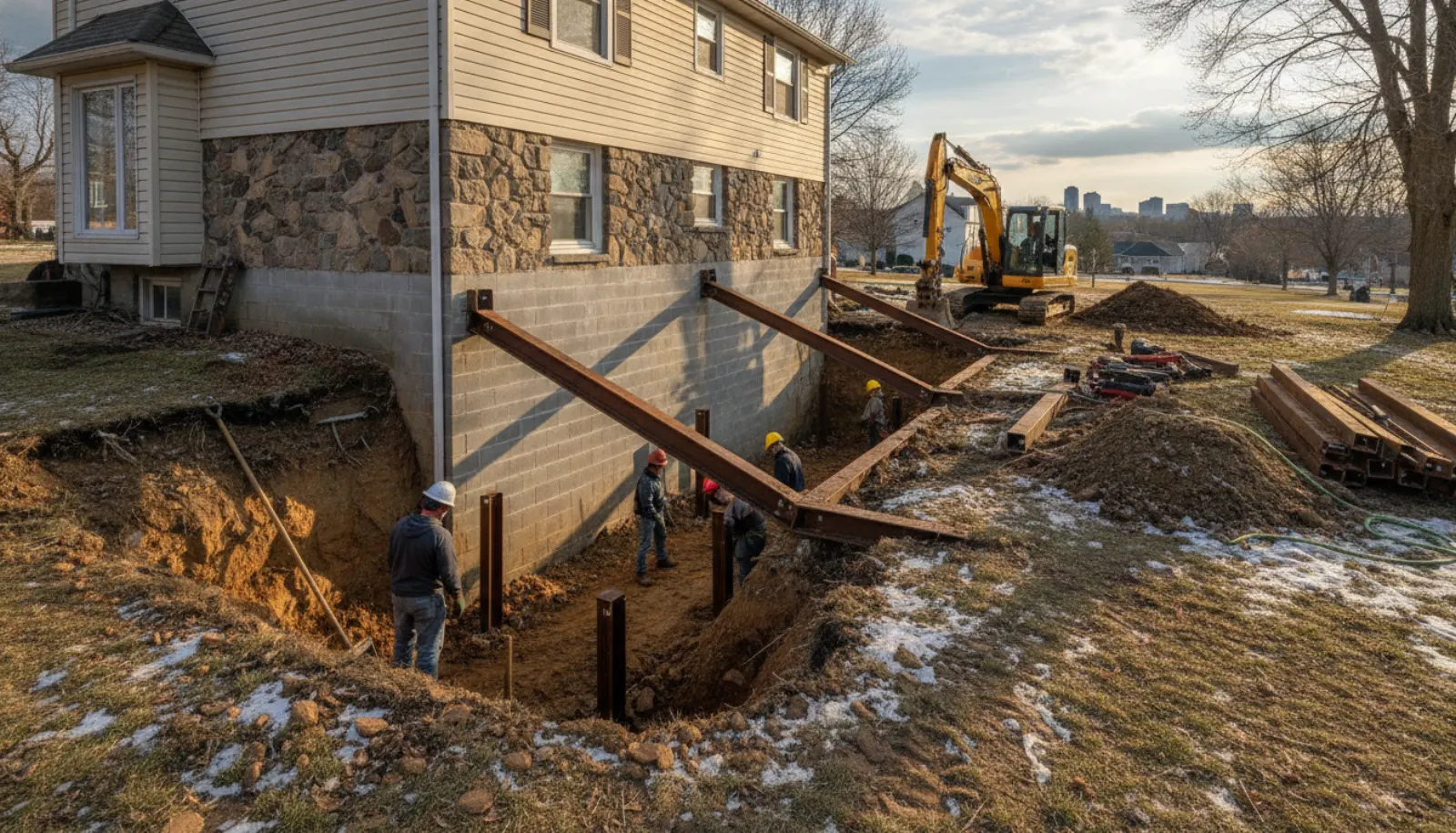
When a corner or section is settling. Steel piers are driven under the footing to firmer ground and the load is moved onto them.

Water control

In every case. Gutters, downspouts and grading so less water sits by that part of the wall.

What it typically costs

National guides put repointing at about $5 to $25 per square foot. Carbon fiber or steel straps for a bowing wall run about $4,000 to $12,000. One national guide puts steel push piers at about $1,500 each, or $9,000 to $15,000 for most jobs. Most foundation repairs in the U.S. fall between $2,200 and $8,200. These are typical ranges, not quotes. Your free inspection gives you the real number in writing.

What to do before the inspection

  1. Draw a pencil line at each end of the crack and write the date.
  2. Take a photo with a coin or ruler held against the widest part.
  3. Look at the outside of the same wall for matching cracks.
  4. Check doors and windows upstairs near that wall.
  5. Check again after the next big freeze or thaw.

Frequently asked questions

Are stair-step cracks in a block foundation normal?

A hairline stair-step crack that never changes is common in older block walls. A crack you can fit a coin in, one that is growing, or one where the blocks on each side no longer line up is not normal and should be checked.

Can I just fill the crack with mortar or caulk?

You can, and it may keep water out for a while. But if the wall is still moving, the crack opens again, often right next to your patch. Find out why it cracked first, then seal it.

What does a stair-step crack near a corner mean?

Often that the corner is sinking a little, so the crack runs up and away from the low point. It can also mean the long wall is bowing in and bending against the corner. The inspector checks which one it is.

How wide is too wide?

As a rough guide, cracks wider than about a quarter inch, or ones that grew since you marked them, deserve a look. So does any crack where one side sticks out past the other.

Why do the cracks in my brick front keep coming back after repointing?

New mortar fills the gap but does not stop the movement under it. If the footing under that part of the house is settling, the crack comes back. A fix under the wall may be needed before the brick work holds.

Get the crack checked

A free inspection tells you whether your crack is old news or a wall on the move. Call (315) 623-3956 or send the short form, and a local foundation crew will call you back, usually the same day. The price comes in writing.

(315) 623-3956 Free inspection