Skip to content
Syracuse Foundation

Serving Syracuse and nearby areas

House Settling in Syracuse, NY

When one part of a house keeps settling, the soil under the footing has softened or shifted, so get a free inspection in Syracuse to see if it is still moving and a written price to stop it.

Book a free foundation inspection

Tell us what you are seeing. A local specialist calls you back the same business day.

Why basements crack and leak in Syracuse

Syracuse averages about 127.8 inches of snow a year and has averaged about 134 days a year below freezing. Snowmelt soaks slow draining glacial till and lake clay soils, then the soil freezes and pushes on basement walls. About 43 percent of the city's homes were built in 1939 or earlier, many on stone or early block walls.

What it costs

Typical published ranges for Syracuse. The contractor's written estimate is the price, and the inspection is free.

WorkTypical range
Inspection and written estimate Free
Steel push piers, most jobsabout $1,500 per pier, national guide $9,000 to $15,000
Helical piers, most jobsabout $3,000 per pier, national guide $15,000 to $30,000
Most foundation repairs, national $2,200 to $8,200

See typical foundation repair prices in Syracuse

What settling looks like

Settling shows up as a pattern. One part of the house drops, and everything built on it bends toward that spot.

Cracks that point to one corner

Stair-step cracks in block or brick that run up and away from the low corner.

A crack wider at the top

A crack in the foundation that opens more at the top than the bottom.

Sticking doors on one side

Doors and windows on the low side drag, will not latch or have uneven gaps.

Diagonal cracks upstairs

Cracks running up from the corners of doors and windows toward the sinking side.

A floor that runs downhill

The floor slopes toward one outside wall or corner.

A porch or chimney pulling away

A gap opens where the porch, steps or chimney meet the house.

Gaps at the top of the wall

Space between the foundation and the sill, or between walls and ceiling.

Why houses settle in Syracuse

Water under one spot. The city averages about 127.8 inches of snow a year, the most on one ranking of the snowiest U.S. cities. All that melt runs off the roof. A downspout that empties at one corner year after year keeps the soil under that footing wet and soft, and it can wash fine soil away.

Mixed glacial ground. The Syracuse area sits on what the glaciers left. North of the city, flat land formed under glacial Lake Iroquois. Around it are drumlins of packed till. Some lake soils, like the Schoharie series, have subsoils over 35 percent clay. Till soils like the Honeoye series can have a dense layer 20 to 38 inches down. Soil can change from one end of a house to the other, so one side can settle more than the other.

Frost. Syracuse has averaged about 134 days a year below freezing. Footings in New York are set around 4 feet down to stay below the frost line. Older additions, porches and steps were often built on shallower footings, and those can heave and settle with the frost.

Old houses, old additions. About 43 percent of homes in Syracuse were built in 1939 or earlier. Many have had a kitchen, porch or room added later on a different footing than the main house. The joint between old and new is a common place for settling cracks.

When it is normal and when it is serious

Usually old, finished settling:

  • Hairline cracks that have not changed in years
  • A slight slope you have always had
  • Doors that were planed once and have closed fine since

Get it looked at soon:

  • Cracks that grow, or new ones that show up
  • One corner clearly lower than the others
  • A crack wider than about a quarter inch, or one side sticking out
  • Doors and windows on one side that started sticking at the same time
  • A porch, chimney or addition pulling away

What the fix usually is

The inspector checks how much the house has dropped, whether it is still moving and what caused it. Then:

  1. Fix the water. Downspouts carried well away, gutters cleaned, soil sloped away from the house, leaks repaired.
  2. Watch it. If the settling stopped, sealing the cracks and keeping an eye on them may be enough.
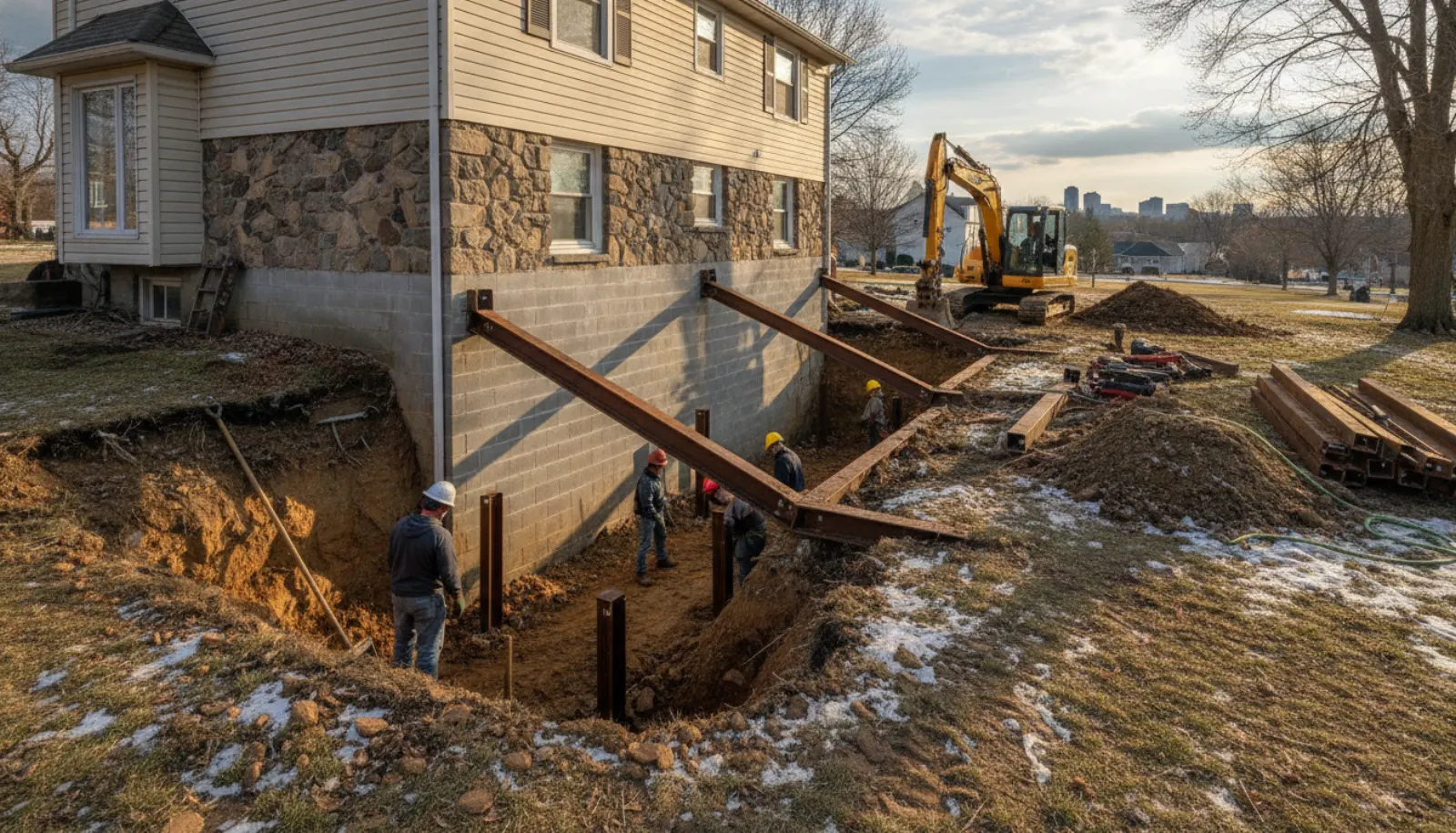
  3. Push piers. Steel pipes driven under the footing down to firm soil, using the weight of the house. The load moves onto the piers.
  4. Helical piers. Steel shafts with screw plates turned into the ground. Often used for lighter parts of a house like porches and additions.

The City of Syracuse Central Permit Office handles permits for work on one and two family homes. Underpinning usually needs one, and the contractor should pull it.

What it typically costs

One national guide puts steel push piers at about $1,500 each and $9,000 to $15,000 for most jobs. Helical piers run about $3,000 each and $15,000 to $30,000 for most jobs. When the fix is water control and crack sealing, it costs far less. Most foundation repairs in the U.S. fall between $2,200 and $8,200. These are typical ranges, not quotes. Your free inspection gives you the real number in writing.

What to do before the inspection

  1. Mark every crack with a pencil and the date.
  2. Note which doors and windows stick, and since when.
  3. Walk outside and look where each downspout lets out.
  4. Check for a leaking pipe or a wet spot near the low corner.
  5. Take photos of the porch, steps and chimney where they meet the house.

Frequently asked questions

Do all houses settle?

Yes, most houses settle a little in the first years as the soil under the footings packs down. In an older Syracuse home that settling ended long ago. New cracks or doors that just started sticking mean something has changed.

How can I tell if my house is still settling?

Mark the ends of cracks with a pencil and the date, and photograph them with a ruler. Check after a thaw and after a dry summer. If cracks grow or new ones show up, the house is still moving.

What causes one corner to sink?

Usually water. A downspout that dumped at that corner for years, a leaking pipe, or poor grading can soften the soil under the footing. Soft fill soil, an old addition on a shallow footing, or tree roots drying the soil can do it too.

Are piers the only fix for settling?

No. If the settling stopped, fixing the water and sealing the cracks may be all you need. Piers are for a part of the house that is still going down, or one that has dropped enough to cause real damage.

Will piers lift my house back up?

Piers can sometimes lift a settled corner part of the way back. How much depends on the house and what is above it. The crew should tell you whether the goal is lifting or just stopping the drop.

Is settling covered by homeowners insurance?

Usually not. Most policies leave out settling, soil movement and wear. Ask your agent, especially if a burst pipe caused the soil to wash out, since that cause may be treated differently.

Get the settling checked

A free inspection tells you whether your house finished settling long ago or is still on the move. Call (315) 623-3956 or send the short form, and a local foundation crew will call you back, usually the same day. The price comes in writing.

(315) 623-3956 Free inspection