Skip to content
Syracuse Foundation

Serving Syracuse and nearby areas

Bowing Basement Walls in Syracuse, NY

A bowing basement wall means the soil outside is pushing harder than the wall can hold, so get a free inspection in Syracuse and a written price to stop it before the next winter.

Book a free foundation inspection

Tell us what you are seeing. A local specialist calls you back the same business day.

Why basements crack and leak in Syracuse

Syracuse averages about 127.8 inches of snow a year and has averaged about 134 days a year below freezing. Snowmelt soaks slow draining glacial till and lake clay soils, then the soil freezes and pushes on basement walls. About 43 percent of the city's homes were built in 1939 or earlier, many on stone or early block walls.

What it costs

Typical published ranges for Syracuse. The contractor's written estimate is the price, and the inspection is free.

WorkTypical range
Inspection and written estimate Free
Carbon fiber or steel straps, one walltypical ranges, national guides $4,000 to $12,000
Wall anchors $1,500 to $2,000per anchor
Bowing wall repair, whole job $4,000 to $15,000
Structural engineer report $300 to $2,000

See typical foundation repair prices in Syracuse

What a bowing wall looks like

A bowing wall does not always look dramatic. Most people find it by accident while moving boxes or painting. Here is what you will notice.

A long sideways crack

A crack that runs along one mortar line, often three or four rows of block down from the top.

A belly in the middle

Hold a level or a straight board on the wall. If there is a gap behind the middle, the wall has moved.

A top row that slid in

The top course of block sits further into the basement than the rows below it.

A step at the bottom

The bottom of the wall has slid in past the floor, leaving a ledge.

Stair-step cracks at the ends

Zigzag cracks near the corners, where the wall bends against the walls that hold it.

Gaps at the sill

A space between the top of the wall and the wood sill plate or joists above it.

Why walls bow in Syracuse

The soil outside your basement is heavy, and in Syracuse it is wet and cold for a big part of the year.

The city averages about 127.8 inches of snow a year, the most on one ranking of the snowiest U.S. cities. When that snow melts, the soil against your wall soaks it up. Wet soil weighs more and pushes harder than dry soil.

Then it freezes. Syracuse has averaged about 134 days a year below freezing. Footings in New York are set around 4 feet down to stay under the frost line, but the soil against the upper part of the wall still freezes. Wet soil swells when it freezes and shoves the wall inward. It thaws, soaks again, and freezes again.

The soil type keeps the water there. Some lake soils in the region, like the Schoharie series, have subsoils over 35 percent clay. Till soils on the local drumlins, like the Honeoye series, can have a dense layer 20 to 38 inches down. Neither drains fast.

Last, the walls are old. About 43 percent of homes in Syracuse were built in 1939 or earlier, and another third between 1940 and 1969. Many of those basements have hollow block or stone walls. Block walls are strong pressing down, but weak when pushed from the side. They bend at the mortar joints, which is why the crack runs sideways.

How bad is your wall?

Bowing walls tend to move in stages. Knowing the stage tells you what the fix may be.

  1. Early. A thin sideways crack, little or no bow you can measure. Often fixed with straps.
  2. Moving. A bow you can see with a level, up to around two inches. Straps may still work, or anchors.
  3. Serious. A bow past about two inches, a top row that slid, or a crack with one side sticking out. Anchors or steel braces are common.
  4. Failing. The wall has sheared at the bottom, is crumbling, or leans enough to worry about the floor above. Part of the wall may need to be dug out and rebuilt.

Each winter can move a wall further along that list. That is why a wall that "has looked like that for years" is still worth a check.

What the fix usually is

The inspector measures the bow, looks at the wall material and checks what is above the wall and outside it. Common fixes:

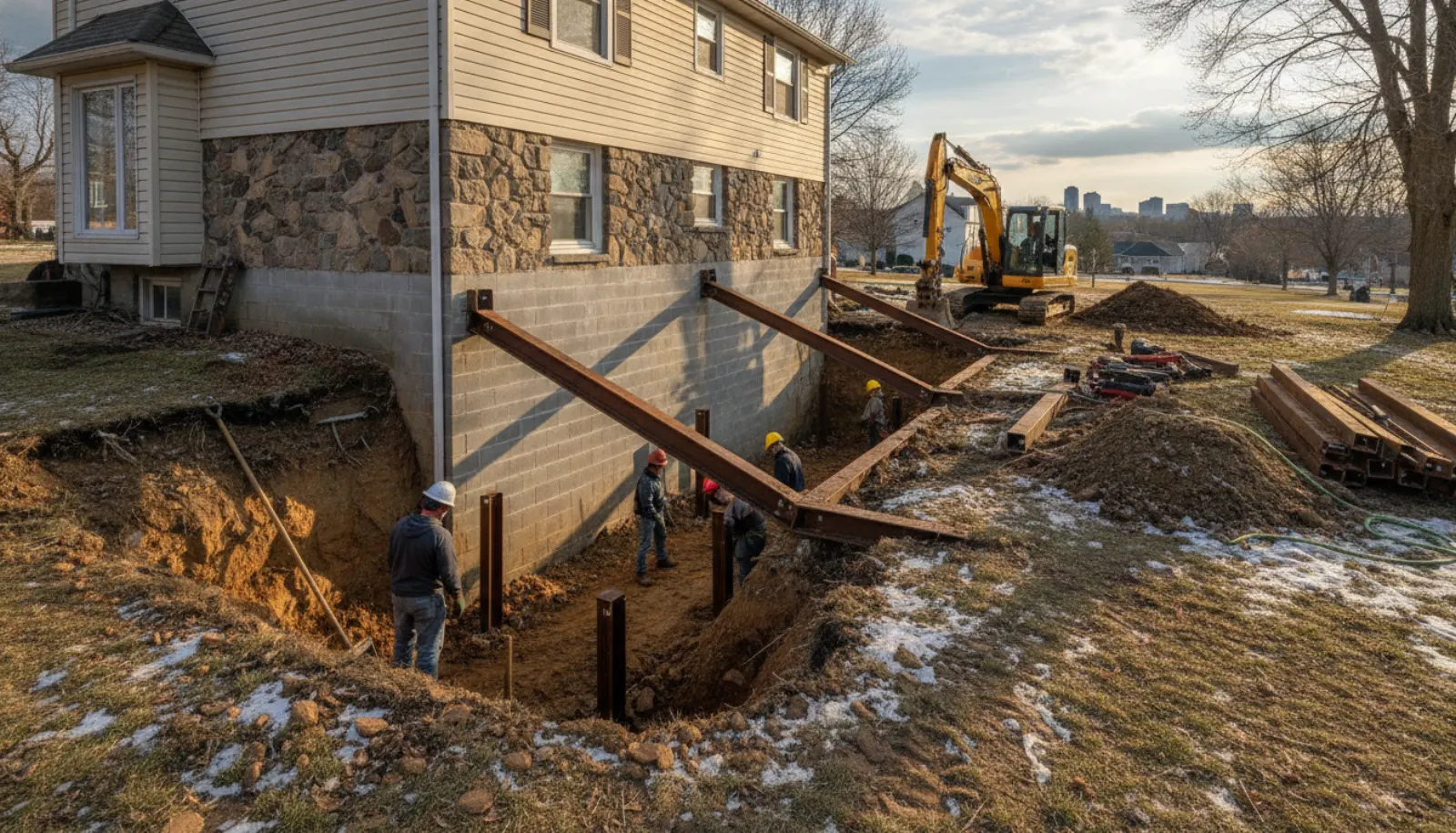
Carbon fiber straps

Glued to the wall every few feet. No digging. Best for smaller bows.

Wall anchors

With a plate inside, a rod through the wall and an anchor buried in the yard. They can be tightened later.

Steel braces

That run from the floor to the joists. Good where the yard has no room for anchors.

Partial rebuild

Where the wall is past saving, often paired with drainage outside.

In the City of Syracuse, the Central Permit Office handles permits for work on one and two family homes. Structural work usually needs a permit, and the contractor should pull it.

What it typically costs

National guides put carbon fiber or steel straps at about $4,000 to $12,000 for a wall, and wall anchors at about $1,500 to $2,000 each. A whole bowing wall repair usually falls between $4,000 and $15,000. A rebuild costs more. These are typical ranges, not a quote. Your free inspection gives you the real number in writing.

What to do before the inspection

  • Mark the ends of the crack with a pencil and the date.
  • Take a photo of a level held against the wall, with a tape showing the gap.
  • Point downspouts at least a few feet away from that wall.
  • Move shelves and boxes back so the crew can see the whole wall.
  • Note if the wall gets wet, and when.

Frequently asked questions

How much bowing is too much?

Any bow is worth a look, because walls rarely move back on their own. As a rough guide, under about an inch is often held with straps. Two inches or more usually needs anchors or steel braces. A wall that has slid at the bottom or cracked through may need part of it rebuilt.

Is it safe to live in a house with a bowing basement wall?

Most bowing walls move slowly, over years, and people live in the house the whole time. The risk grows each winter the wall keeps moving. If the wall moved fast, has a wide crack with one side sticking out, or the floor above has dropped, call soon.

Can a bowed wall be pushed back straight?

Sometimes, a little. Wall anchors can be tightened over time, often during dry months, and may pull a wall back part of the way. Straps and braces mostly hold the wall where it is. Ask what result to expect before you sign.

Will fixing the gutters stop my wall from bowing?

It helps, and it is worth doing either way. Less water against the wall means less weight and less frost push. But a wall that has already bowed has lost strength, so it usually needs support too.

Does a bowing wall hurt my home sale in Syracuse?

Buyers and their inspectors look for it, and it often comes up in the inspection report. A repair with written paperwork and a warranty is much easier to explain than an open problem.

Get the wall checked

A bowing wall does not fix itself, and Syracuse winters keep pushing. Call (315) 623-3956 or send the short form, and a local foundation crew will call you back, usually the same day. The inspection is free and the price comes in writing.

(315) 623-3956 Free inspection